
The Challenge of Modern Project Management
Have you ever felt overwhelmed by impossible deadlines, constantly changing scopes, and communication breakdowns in your team? In today's dynamic market, flexibility and speed are not just competitive advantages; they are matters of survival. That is exactly where Scrum comes in. More than a methodology, Scrum is an agile, lightweight, and adaptive framework that helps people, teams, and organizations generate value through innovative solutions to complex problems. In this complete guide, you will understand in detail how Scrum works, its origins, frameworks, and how to apply it to transform your business results.
The Origin of Scrum: Who Created It and What Are the References?
Scrum was created in the early 1990s by Jeff Sutherland and Ken Schwaber. They were looking for an alternative to traditional software development methods (such as the Waterfall model), which were rigid and frequently resulted in late and over-budget projects.
The main theoretical reference for the creation of Scrum was a 1986 Harvard Business Review article called 'The New New Product Development Game', written by Hirotaka Takeuchi and Ikujiro Nonaka. In this article, the authors compared the work of high-performance teams to the sport of Rugby, where the team advances together, passing the ball from hand to hand.
It was from this analogy that the term Scrum emerged (the restart play where players pack together with their heads down to contest the ball).
The Three Pillars of Scrum Theory
Scrum is founded on empiricism, which asserts that knowledge comes from experience and making decisions based on what is known. To support this empirical model, Scrum relies on three fundamental pillars:
The 5 Scrum Values
For the pillars to work, the Scrum team needs to live five values in their daily lives:
Roles in Scrum: Who is Who in the Team?
Product Owner (PO)
The PO is solely responsible for maximizing the value of the product resulting from the work of the Scrum Team. They own the product vision, managing and prioritizing the Product Backlog, translating the needs of customers and stakeholders for the development team.
Scrum Master (SM)
The Scrum Master is the servant leader focused on helping everyone understand and apply Scrum theory and practice. They act as a facilitator, removing impediments that hinder the team's progress and shielding the team from external distractions.
Developers
Developers are the people on the Scrum Team who are committed to creating any aspect of a usable Increment each Sprint. They are self-managing and cross-functional, possessing all the skills necessary to deliver the work done.
Events and Artifacts: The Rhythm of Agility
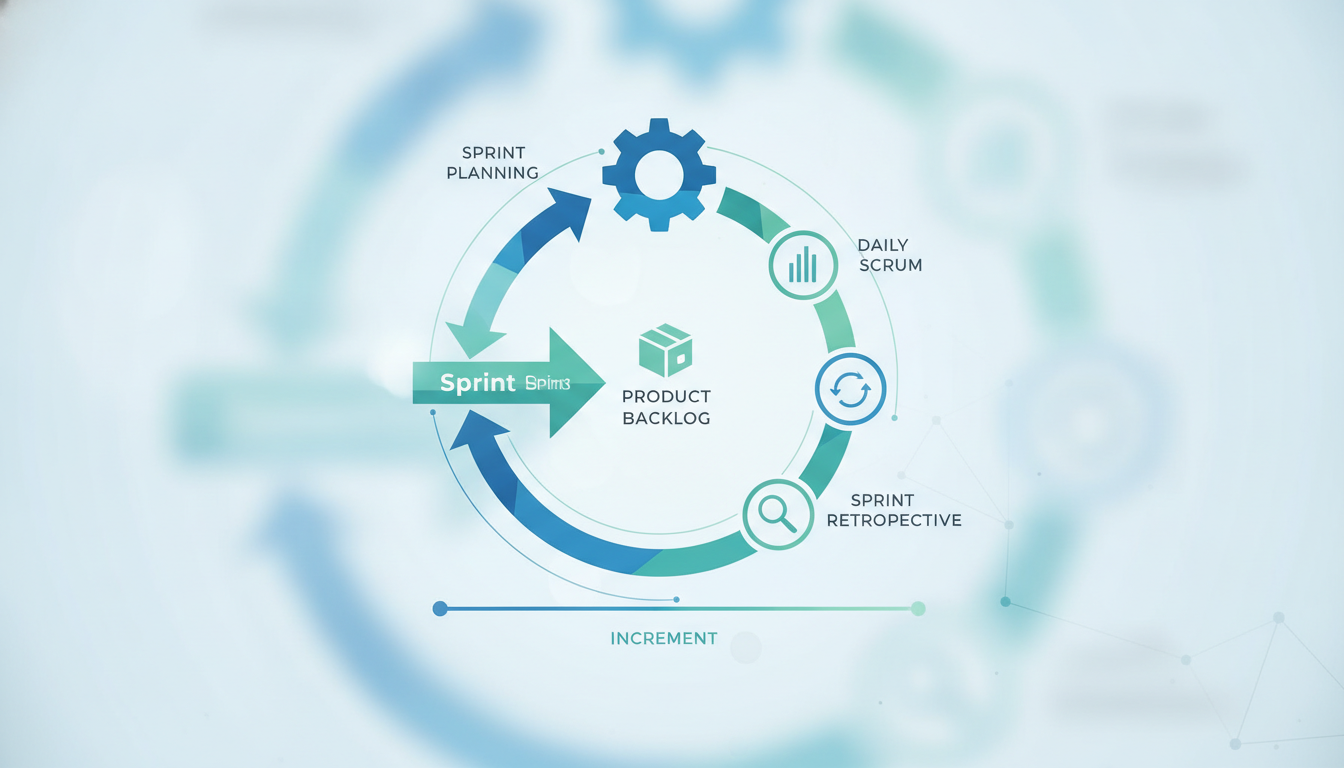
Scrum works through fixed-length cycles called Sprints (usually 1 to 4 weeks). Each Sprint contains specific events that structure the workflow:
Sprint Planning: Planning where the team defines what will be done and how* the work will be performed.
These events generate and inspect three fundamental Artifacts:
Scrum in the Context of Scaled Agile
When organizations grow and need to coordinate multiple Scrum teams working on the same complex product, the need for Scaled Agile arises. Frameworks such as SAFe (Scaled Agile Framework), LeSS (Large-Scale Scrum), and Nexus adapt basic Scrum practices for dozens or even hundreds of teams, ensuring strategic alignment, release synchrony, and agile governance without losing the essence of autonomy and end-to-end value delivery.
Indispensable Tools for Agile Managers
To manage all these events and artifacts and ensure transparency with the team and stakeholders, modern managers use various market tools. Among the most popular are:
Transform Your Management with Our Platform
Implementing Scrum is a fundamental step to making your company more agile, adaptable, and customer-focused. However, for this process to run smoothly, having the right technology makes all the difference. If you want to simplify project management, centralize your team's communication, and track agility metrics in real time, we have the ideal solution. Discover our platform right now and find out how we can help your team soar in agile culture and reach new heights of productivity.
Frequently Asked Questions (FAQ)
1. What are the three core pillars of Scrum?
The three core pillars of Scrum are Transparency, Inspection, and Adaptation. Transparency ensures all aspects of the process are visible to those responsible for the outcome. Inspection allows teams to frequently evaluate their progress, enabling timely Adaptation to make necessary adjustments.
2. What are the main roles in a Scrum team?
A Scrum team consists of the Product Owner, the Scrum Master, and the Developers. The Product Owner maximizes product value by managing the backlog, while the Scrum Master facilitates the framework and removes impediments. The Developers are dedicated to creating a usable, valuable increment during each Sprint.
3. How long should a typical Scrum Sprint last?
A typical Scrum Sprint lasts between one and four weeks, with two weeks being the most common duration. Keeping Sprints short reduces complexity and allows teams to deliver value faster while gathering continuous feedback. Longer timeboxes are generally discouraged as they increase project risk and delay necessary adjustments.
4. What is the difference between Scrum artifacts and Scrum events?
Scrum artifacts represent work or value and include the Product Backlog, Sprint Backlog, and Increment. Scrum events are timeboxed meetings designed to facilitate inspection and adaptation, such as Sprint Planning, Daily Scrum, Sprint Review, and Sprint Retrospective. Artifacts provide transparency, whereas events create structured opportunities for collaboration.
5. Can Scrum be applied to teams outside of software development?
Yes, Scrum can be successfully implemented in non-software fields such as marketing, human resources, operations, and product design. The core principles of iterative delivery, team self-management, and continuous feedback apply to any complex project requiring agility. Adapting Scrum helps various industries improve collaboration and respond rapidly to changing market demands.